

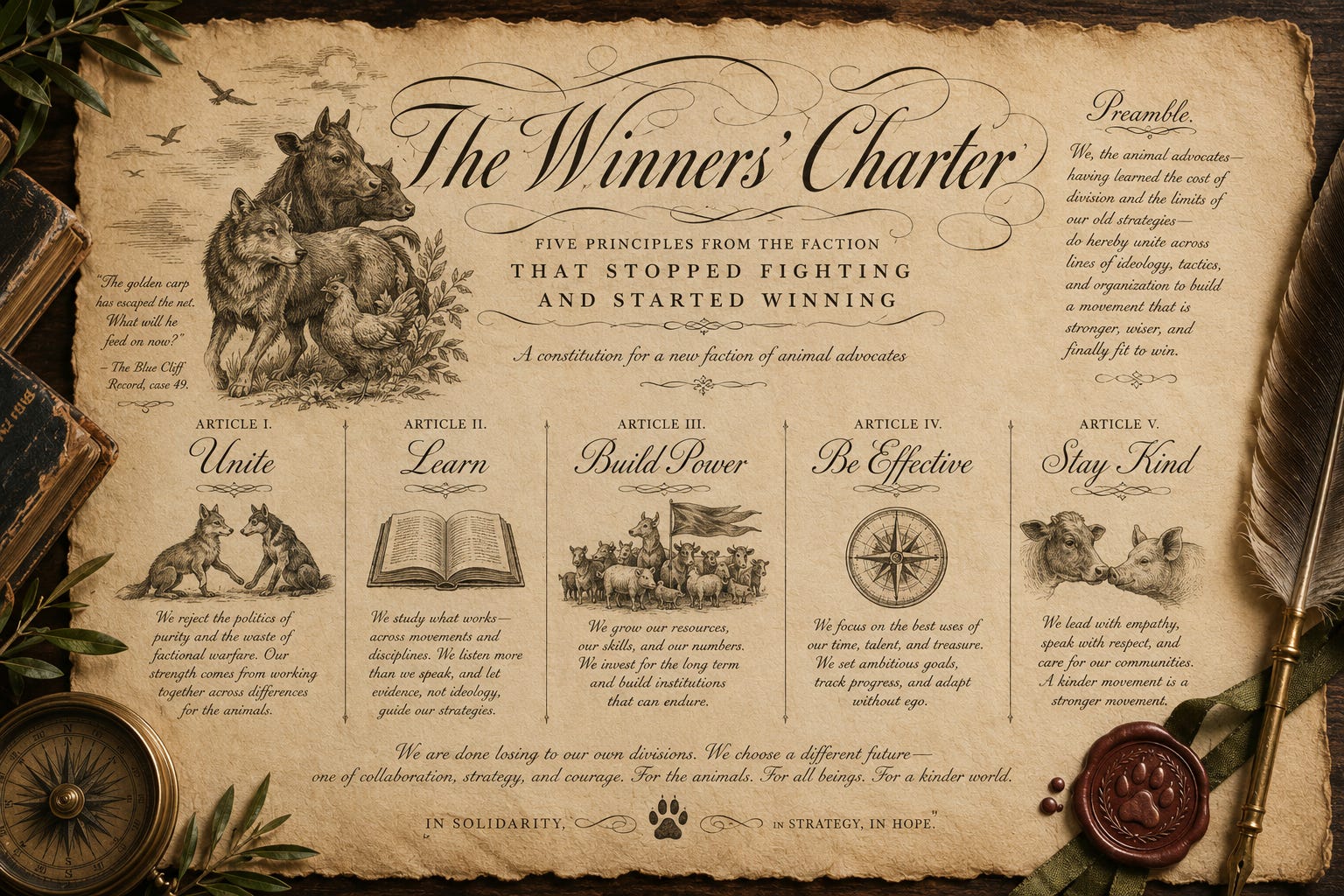
The Winners’ Charter
Five principles from the faction that stopped fighting and started winning.

“The golden carp has escaped the net. What will he feed on now?” - The Blue Cliff Record, case 49
A New Gospel
I usually don’t attend talks at conferences. Four years ago I bumped into Elliot Teperman in the hallway outside a talk at AVA and asked if he was going in, and he explained that he typically opts for the “hallway track”, as in skipping the talks to stand in the hallway catching whatever opportunities for spontaneous 1-on-1 conversations might float by. He looked Very Cool saying this, though I wasn’t sure if maybe that was just because he was Australian. But then we had a great spontaneous conversation, which seemed to validate the whole theory.
Ever since then, I’ve been a Hallway Track™ kind of guy. Filter-feeding in the hallway on the high concentration of unusual people at animal advocacy conferences, I’ve had amazing conversations, a few of them life-changing. And most of the time when I choose to go listen to a talk instead, it’s boring and I regret it.
One of the only exceptions I make is to support my friends by listening to their talks. But at the Grassroots Animal Rights Summit (GARS) in Washington D.C. last month, just about every speaker met this criterion. So I mentally prepared myself for a weekend of fidgeting in my chair and half-listening to my friends’ talks.
This is not what ended up happening.
Opening talks
The first talk was by Penimah Tehilah of Animal Activist Collective, a co-host of the summit. Now, the opening talk of any conference has a clear job. I learned this in my own years managing the speakers and trainings schedule for the Animal Liberation Conference (ALC), a predecessor to GARS that DxE hosted from 2017-2023 or so.1
From the getgo, you’ve got to lay out a shared vision and purpose broad enough to encompass everyone present but specific enough to energize and inspire them. This was a different task at GARS than at ALC, because the grassroots animal movement has grown a lot in the intervening years. It’s not bigger– the largest ALC was nearly five times the size of this year’s inaugural GARS. But it is wider.
Back then, the animal movement was defined by its divisions. First there was the big factional split: the radical abolitionist intersectional idealist scrappy grassroots vs. the moderate pragmatic single-issue welfarist professional NGOs.
These factions did not talk to each other except to argue. We barely thought of ourselves as part of the same movement. In the 2010s, I knew of only one or two people who could walk amongst both without feeling like they were behind enemy lines.
Yet the strongest resentments were reserved for more fine-grained divisions within each camp. To name just a few:
Open vs. closed rescue: rescuing animals directly from farms is radical direct action by any lights. Yet the underground and above-ground versions of rescue inspired fierce division. Open rescue proponents implied that ALF activity was flirting with violence, while some ALF veterans earnestly believed DxE founder Wayne Hsiung was a federal agent sent to bait promising young activists down the primrose path to long prison sentences.
Outreach styles: after a large portion of the movement soured on individual vegan outreach, those who remained committed to it enjoyed a bitter feud over persuasion techniques, with some favoring socratic methods and others a stern approach modeled on addiction interventions.
Last but certainly not least, who to cancel: activist communities who were in 98% perfect agreement about which particular views or individuals should be banished from public life sundered themselves over the remaining 2%.
All these divisions had one strange benefit: nothing motivates people like intergroup hatred, at least in the short term. DxE was one of several groups that used factionalism to build intense commitment to the movement among its members. It worked on me. I remember the talk that first convinced me to join DxE. Whether or not it was Wayne’s intention, my takeaway was that the rest of the movement were somewhere between unambitious pushovers and welfarist sellouts, and that DxE’s analogy to historical social movements was the only winning strategy.
Years of abject failure also have a benefit, which is convincing you that maybe your theory of change is not the only one worth paying attention to after all. So it was that after eight years, I finally made some friends across the aisle. Once I met them, I started to think the other side weren’t so bad. We could get along, even! I started trying to explain this to my abolitionist compatriots, arguing that these two sides were actually helping each other whether we realized it or not.
But I was still thinking in terms of sides– namely, the inside and the outside. I had begrudgingly accepted that there was a place for incremental welfare campaigns like cage-free eggs. But that didn’t mean I was going to work on those campaigns. I was going to stay in my comfortable, radical, outside-game lane, hands unsullied by the compromises of the inside game.
This, too, passed. I shared a few weeks ago the story I see as the turning point, not so much for me as for the whole abolitionist grassroots network:
For all of September 2024, Pro-Animal Future rented an airbnb in Denver to host activists from across the country to help with our ballot initiative campaign (a ban on slaughterhouses). Most of the people who came were hardcore abolitionist protesters from the East Coast, brought together thanks to AAC. A couple of those attendees happened to pay the bills through day jobs at welfare campaign orgs like The Humane League and Mercy for Animals. One night after petitioning was over, one of these organized a protest for a cage-free campaign, and asked everyone in the house to go.
This was a pretty edgy request. It would be all their first time participating in a welfare campaign. They dragged their heels, but ultimately, they’d spent the last three weeks petitioning with this person. She was their friend, and they all went to support her.
So it was that a company of fifteen rowdy abolitionists showed up to a suburban Taco Johns in Westminster, Colorado on a weeknight for what may have been the largest crossover between the abolitionist and welfarist movements in more than a decade. You won’t be surprised that things did not go as expected. It was the most raucous cage-free protest in living memory, ending with local police arresting the entire group– the first arrests in that organization’s 12-year history.
I’m still amazed how quickly things changed from there. That night was a crack in the ice that precipitated a nearly complete thaw in the welfarist-abolitionist feud. For the last year, the previously unthinkable coalition of ICAW, AAC, and CAFT have been rampaging across the world campaigning for fur and foie gras bans alongside cage-free eggs and shrimp welfare reforms. People who once could barely look cage-free campaigners in the eye have been tackled to the ground screaming for a CAGE-FREE POLICY! inside corporate board meetings.
The strangest thing about all of this was how quickly it became ordinary. Unremarkable. Boring, even. That’s how I was feeling about it as Penimah launched into her talk in DC. I spent the first half nodding along and thinking that, yeah, she was doing the thing, shouting out the breadth of different organizations and theories of change present at the summit.
Around half way through the talk, she threw this image onto the screen to describe the state of the movement when she’d first gotten involved:
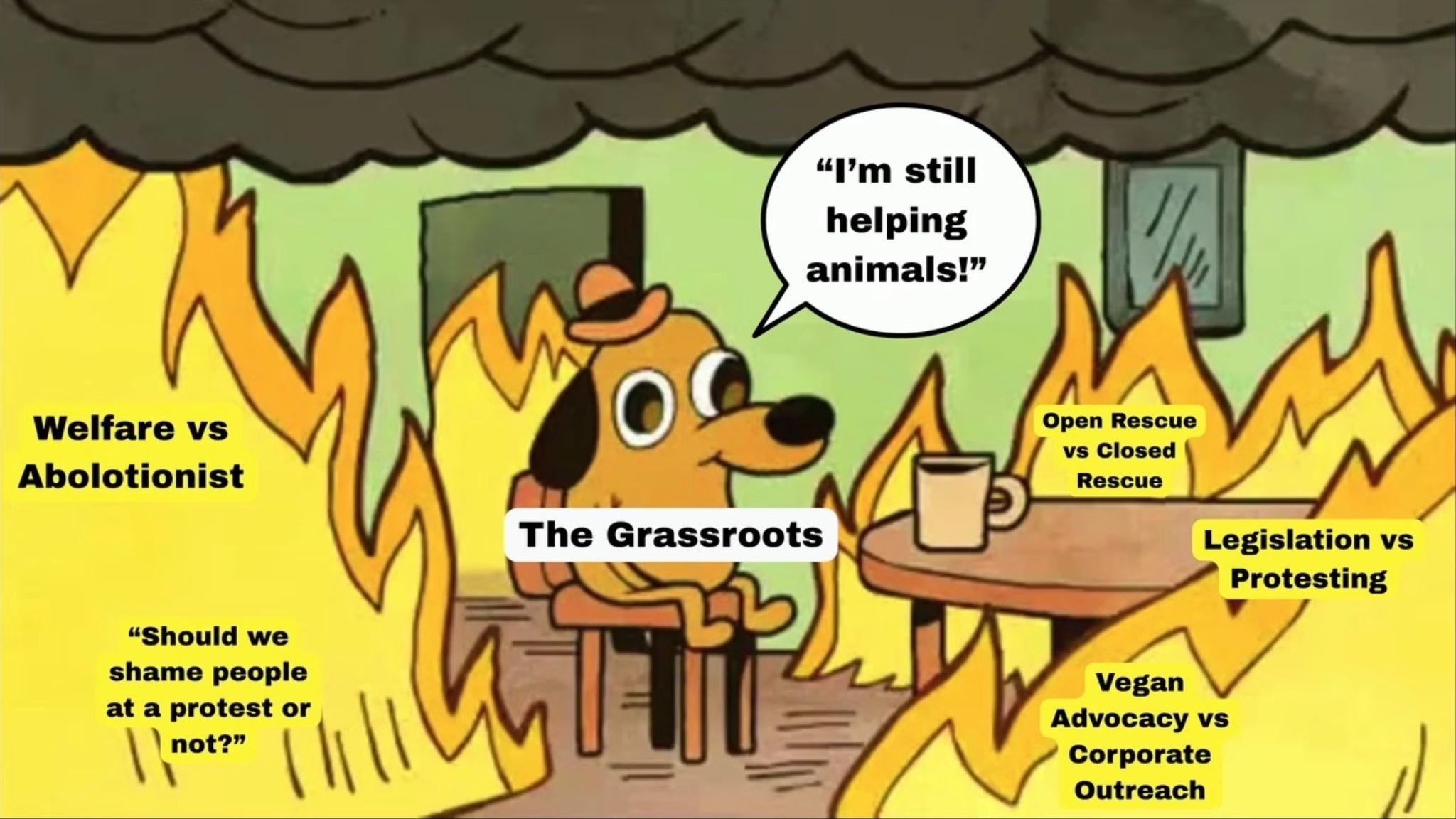
And it hit me all of a sudden just how unthinkable this talk would have been during the years I was organizing the ALC– not least because I never would have allowed it! My eyes watered up as I relived the three-year process of trading in my narrow, dogmatic certainties on each of these questions. All the energy we wasted on pointless, misguided infighting, and the animals whose lives are worse today because of it.
From that point on, I was on the edge of my seat. Every talk for the rest of the conference subtly revealed the ways different corners of the movement have matured, increasing our capacity for complexity and nuance. Taken together, they laid out the charter of a new faction:
Team Win
As the name implies, it is defined by only one thing. It is made up of the people who care less about identitarian factional disputes and more about winning– any victory, by any means. As we’ll see, Team Win is not one specific coalition, or disposition, or theory of change. It’s bigger than just the groups at GARS. But it’s not big enough.
I wish there were only Team Win, but there is another team: Team Division. Stuck in the past, they want the movement to stay divided along the same old factional lines. Many of them don’t even realize they are on the same team. They think that spending all their time fighting each other makes them adversaries. I know, I know– so 2016! But they do. Whether abolitionists refusing to reckon with the evidence base for welfare campaigns or tunnel-visioned EAs hand-waving the transformative power of mass mobilization, members of Team Division haven’t heard the gospel yet.
Today, I have come down from the mountain to deliver it. Inscribed on these tablets is the new chapter of the animal rights movement. I didn’t write it– it’s been taking shape for years. After you read it, you’ll have no excuse for pretending we’re still in the last one.
The future is Team Win. Like you, I was dragged into it kicking and screaming. But reader, it’s so much better on the other side over here. Come join us.
The Winners’ Charter
Principle #1: Any win by any means
A founding member of Team Win2 told me about the speech he always gives at activist gatherings. He starts by reminding everyone of the daily horrors inflicted on animals in farms and laboratories, stirring their righteous rage. Then he asks:
How far would you go to achieve animal liberation?
[The crowd cheers.]
Would you do whatever it takes?
Yes! [comes the reply.]
Would you break the law?
[They respond even louder] yes!
Would you go to prison for animals?
Yes!! [It’s fewer voices, but more emphatic.]
Banging his fist on the table: Would you give your life for animals if that’s what it took to win?
Yes! [They scream out in religious fervor!]
[Grabbing the podium like a Baptist preacher, voice thundering out across the crowd]: Alright then. Would you get a hair cut, put on a suit, and go schedule meetings with politicians and corporate boards of directors?
[Quiet murmurs spread across the room as the activists exchange confused looks with one another.]
Winning requires sacrifice, reader. But sometimes the most important sacrifices, and even the most difficult ones, are not the most dramatic.
My friend Jakub Stencel (goes by Kuba), executive director of Anima International, once told me a lesson about strategy he learned from playing competitive video games and board games. You might think that games are about having fun. Jakub would politely disagree.
Kuba was once part of a competitive team for a game called Project Reality, a military game designed to simulate real warfare as closely as possible. Its creators bragged about using real field recordings of main battle tanks from different militaries, such that experienced players could tell just from sound whether an approaching tank was of American, German, or Russian provenance.
But Kuba quickly found out that other players weren’t totally serious about simulating real war. They were too interested in having fun. Even die-hard military nerds would rush ahead faster than you would if it was really your body walking out into the possible line of fire from real bullets.
By contrast, Kuba’s team studied every map as thoroughly as a real special forces unit would. They identified the most strategic positions based on their objective. They practiced, measuring exactly where to point to land a smoke grenade in the most advantageous spot.
Then they waited. Sometimes their entire team would sit motionless at attention in front of their screen for 30 minutes at a stretch, waiting for the opposing team to grow impatient. As he tells it, the real battle was against their own boredom. But, finally, they would spot the other team, right in one of the five or so spots they had planned for. The ambush would be triggered and the match would be over in a few seconds.
People hated playing against Kuba’s team. It’s not just that they won every match. It’s that playing against them wasn’t fun at all. And, indeed, this might sound to you like a sociopathic way to play video games. But I tell you what, reader: that’s exactly the sort of sociopath-adjacent methodicism I want on our side in the struggle for animal rights.
While I was visiting Warsaw, Kuba invited me to join a day-long board game with other leaders of Anima. He explained how they play:
We are quite cutthroat. No mercy - only winning. It’s not “haha, we will spend some wholesome time together ❤️”. It will be brutal, you will regret every minute of it, and for days after you will be confused about the nature of reality.
It’s fine if this is not how you want to spend your leisure time. But this is how you should campaign for animals.
Fun follows function
Enjoying activism too much might be a case of suspicious convergence. In a 2016 post by that name, voted as one of the most important posts from the first decade of the Effective Altruism forum, Gregory Lewis asked us to…
Imagine this:
Oliver: … Thus we see that donating to the opera is the best way of promoting the arts.
Eleanor: Okay, but I’m principally interested in improving human welfare.
Oliver: Oh! Well I think it is also the case that donating to the opera is best for improving human welfare too.
Generally, what is best for one thing is usually not the best for something else, and thus Oliver’s claim that donations to opera are best for the arts and human welfare is surprising. We may suspect bias: that Oliver’s claim that the Opera is best for the human welfare is primarily motivated by his enthusiasm for opera and desire to find reasons in favour, rather than a cooler, more objective search for what is really best for human welfare.
In other words, it would be surprising if the form of advocacy we find most fun, intellectually stimulating, personally satisfying, etc., is also the most impactful thing we could be doing. Enjoying our activism is not proof that it isn’t effective, but it warrants scrutiny.
Of course, if we find no pleasure in our advocacy, we’ll have a hard time sustaining it. The best-case scenario is to soberly assess the situation, determine the most promising path forward, and then find a way to modify yourself to enjoy the work needed to carry it out.
The night before the GARS summit in DC, I asked my friend Lincoln Quirk3 whether he enjoyed the more confrontational protests the groups hosting it are famous for. He visibly shuddered before explaining how far outside his comfort zone we were about to go, but that he was pushing through because he was convinced it was effective. Yet by the second day of protests, I glimpsed Lincoln through a crowd of people clocking 115 decibels outside a Marriott hotel, grinning ear to ear.
I am confident that you are capable of this. In practice, there is not only one winning strategy we need to pursue. But that doesn’t mean that every strategy is equally important or valid. You can choose the strategy that best fits your skills and disposition– but you can only choose from among the strategies that cold, hard analysis tells you might be key to victory. And you shouldn’t sell yourself short when deciding what you might be capable of becoming capable of.
Furthermore, you should expect this self-modification process to be continuous and everlasting, because the strategies needed to win are ever-changing. The best activists find a way not only to enjoy strange new strategies, but to relish in the constant novelty itself. What a privilege it is to learn new skills, push your comfort zone in new ways, and experience myriad facets of the struggle to save animals!
GARS attendees spent one evening screaming themselves hoarse outside the home of the CEO of a company on whose board also sits the majority owner of the company that provides water at Milan Fashion Week for continuing to allow fur on their runway. The next day, they suited up and walked into the Capitol building for a day of grassroots lobbying meetings with U.S. senators about the disastrous Farm Bill. I can’t imagine there have been many lobby days before that included convicted animal enterprise terrorists who spent years in prison.
These people really mean it when they say they will do anything. Some of them enjoy all of it; others don’t. But they all know how to celebrate the wins– and wins they get!
One more thing: “any win by any means” doesn’t imply “the end justifies the means.” It’s not about tiptoeing over the boundaries of nonviolence. If anything, it’s a corrective in the opposite direction. Our more common problem is an irrational preference for “radical” tactics. Edgy, confrontational tactics satisfy the countercultural personalities often drawn to animal rights activism in the first place, regardless of whether or not they are what a particular campaign needs at a particular time.
Winners will deploy any strategy short of violence if that’s what it takes. If a company stonewalls every reasonable request for a policy they can afford—one their peers have already implemented—then we will crash their board members’ daughters’ birthday parties. But we’d rather win the easy way.
Principle #2: Direct your critical attention inwards
“Let everyone sweep before their own door, and the whole world will be clean.” – Johann Wolfgang von Goethe
The best talk at the DC summit was also the most heretical: Chrystine Liptrot of the International Council for Animal Welfare giving, among other things, an account of the history of incremental corporate welfare campaigns.
Over the years, many abolitionists—myself included—have claimed that the cage-free campaign was a scheme from the egg industry itself, to tie up animal advocates with a reform that the industry was planning to make anyway for their own profitability rather than seeking more drastic change.
I’m not calling this a conspiracy theory exactly, but there is stronger evidence for 9/11 being an inside job.
As Chrys explained in her talk, when campaigners started targeting larger retailers with cage-free campaigns in the early 2010s, the egg industry reacted by commissioning a series of studies that—surprise, surprise—claimed that keeping hens in battery cages was actually better for them than the expensive transition to cage-free systems.
For a few months, retailers lauded this research in their responses to activists and journalists. Problem was, these studies crumbled under the merest scrutiny. They’d all been paid for exclusively by the industry, and they failed to meet the most basic scientific standards. After a few months, even the most mealy-mouthed corporate PR departments could defend them no longer, and they had to admit that they just didn’t give enough of a shit about hen welfare to switch to cage-free.
Activists escalated, and so began the era of corporate campaigns. Over the years to come, a substantial corpus of independent research piled up showing that cage-free systems represent not just a certain improvement for hen welfare, but a drastic one. Despite this, the industry fought like hell against encroaching cage-freeification, spending millions of dollars to fight against ballot initiatives.
After that, Chrys explained, she never heard about those bogus industry studies again– that is, until DxE started citing them for our own attacks on cage-free campaigns!
For a moment, 200 activists caught their breath. Then a voice called out from the back of the auditorium.
It was Wayne Hsiung!
Wayne had been one of the loudest voices in the movement criticizing welfare campaigns. It was one of the reasons I followed him, joining DxE. If you heard Wayne Hsiung’s voice call out in the middle of a talk about cage-free welfare campaigns 10 years ago, it would have been a disruption. Wayne and a few other activists would have been at that very moment jumping onto the stage, laminated placards in hand, chanting about the evils of humane-washing and of selling animals out to welfare schemes.
Well, yeah, that’s not what was happening. What was happening was Wayne was taking 20 seconds in front of this packed room to publicly apologize, to say he had been wrong to fight against cage-free campaigns. It wasn’t the first time he’s apologized, but it must have been the most dramatic. Even having read his written version of the same apology, there was some inner baby activist held over inside me from ten years ago that needed to hear it directly to really get the message: this fight is over. It never should have happened, but it’s over now.
But hold on, before you take the wrong lesson here. Team Win is not about being all lovey-dovey and never arguing with each other. This would be disastrous for any strategic community. Instead, Team Win has discovered the one simple rule to make debates useful.4
Disagreement without division
Anima International has earned a reputation among advocacy organizations for an extreme commitment to honesty and candor.
Full disclosure: I recently accepted a position at Anima researching strategies to expand the moral circle of artificial intelligence models. Anima might seem like an odd choice for this work. It has almost nothing to do with any of their other programming, which consists mostly of corporate welfare campaigns in Poland, Denmark, and other European countries 6,000 miles from where I live in the AI industry hub of San Francisco.
Naturally, I considered working on this independently of any organization. I chose Anima because it guaranteed me a steady stream of unrelenting critical feedback, both on my work and on my personal flaws. And I haven’t been disappointed. Even knowing their reputation, I’m sometimes shocked at how blunt the feedback regularly shared in their Slack workspace can be– and how gracefully people take it. For instance, when Kuba announced his decision to hire me to a channel with all ~130 members of the organization, he said some nice things, then shared:
My main concerns after the recruitment process are related to our compassion value: his tendency for judgmental framing, and leadership value: courage to speak up when peers are not respecting norms and not tolerating double standards. There are also some light worries about truth-seeking, possible naive consequentialism (but I worry about this with almost everyone we hire), untested ability to work within a larger organization (most of the time he was in leadership position and never had a boss in his life). He also mentioned some of his mistakes to us that he considers judgment lapses.5
I’d like to think of myself as a transparent person, but being introduced to a hundred new people this way felt pretty vulnerable. In any other org I’m familiar with, a message announcing a new hire would be all rainbows and butterflies.
That’s not how Anima works. They don’t want to delude themselves or anyone else by skipping over the ugly bits.
They are helped along in this goal by their Europeanness:
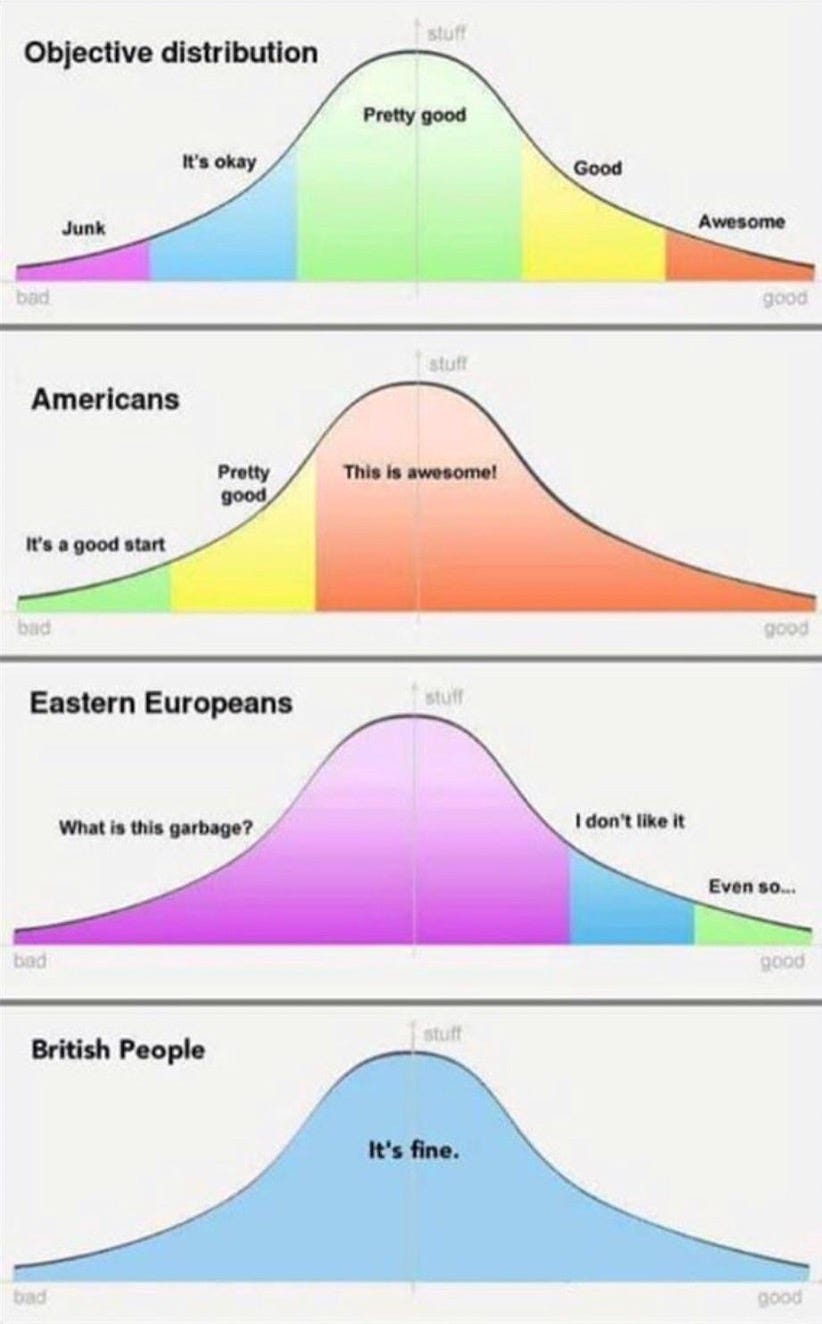
But it isn’t all post-Soviet pessimism. There’s a flip side to this candor that makes Anima special, which was on display as I caught up on old Slack conversations. It is known, in the pantheon of sensationalist, buzzword-filled management books published by Silicon Valley CEOs, as psychological safety. It mostly means being able to trust that when someone gives you critical feedback, they are genuinely doing it in order to build you up, not to tear you down.
I know it sounds like some Hallmark shit but it truly does seem to me like in Anima, people are sufficiently confident they are on the same team that blunt critical feedback from their teammates reads as a gift rather than a threat.
The extent to which Anima aspires to embody this candor is brazen. I’ve been warned that they have a long way to go to fully live up to it– by Anima members, most of all Kuba himself. And while he doesn’t conceal his quintessential Polish skepticism towards the health of our movement as a whole, his sharpest candor is pointed towards his own household.
That’s the key to the second principle of Team Win: don’t suppress your critical energy. Instead, direct it inwards, towards your own theory of change. Focus on making yourself, your organization, and your corner of the movement the best possible versions of yourselves. Do this instead of wasting your time criticizing other people, orgs, and theories of change who are never going to listen to you, and who will probably just dig their heels in harder in response.
I would guess that 10,000s—perhaps 100,000s—of hours have been spent by animal activists debating the merits of individual street outreach to get strangers to go vegan. I might have spent hundreds of these myself arguing why I don’t have much hope for this strategy.
What did I accomplish with all those hours? Besides making myself feel smugly self-righteous, basically nothing. A large portion of the grassroots animal movement is still devoted to vegan outreach. And heck, they should be! Why the hell should they listen to me? It’s not like I have some great record of choosing the best strategies.
It’s good to listen to and seriously consider criticism no matter where it comes from.6 But it’s also good to focus your critical energy on places where it is welcome.
The biggest disagreement on stage at the DC summit wasn’t between welfare and abolition. It wasn’t when DxE’s current leader Almira Tanner shared the stage with ALF ex-con Peter Young for a discussion about the tradeoffs between open and underground rescue efforts; that too was a cathartic love-fest, with each representative praising the merits of the other side’s strategy.7
No, the biggest disagreement was when Wayne and I got up to talk about the Ridglan rescue– our own project!
It wasn’t anything we hadn’t been debating for weeks already, and it was a friendly debate. That’s the whole point: after all these years, Wayne and I have built enough mutual respect that we can skip the pleasantries and dive right into vigorous debate without worrying we’ll offend each other.
The most energetic debates should be inside different theories of change (TOCs), concerning how to execute them at the highest level. That doesn’t mean all TOCs are created equal, and there’s a time and place to question them. But Winners accept that you’re not going to be able to talk people out of their preferred TOC, and persistently trying to do so just creates an adversarial culture. Focus instead on getting your own house in order.
I don’t have much faith in vegan outreach, but I know there will always be a place for it in the movement, and fussing about that only invites us back into the 2010s. I want people whose heart is in vegan outreach to feel like they are part of a broader movement who shows up for each other’s stuff. So when I visit my We The Free friends, I set my ego aside and enthusiastically join them in the streets.
“is a betrayal of the movement” is a betrayal of the movement
A few years back, many of us started using the term “movement ecology.” It was meant to acknowledge the need for many different strategies and theories of change, the way an ecosystem requires many different roles. The implication was, “everyone is playing their part, and there is room for all different theories of change.”
Nobody believes this. And we shouldn’t, because it’s not true. The phrase “movement ecology” isn’t useful as a truth-seeking way to describe the movement. Not all theories of change are correct or equally useful.
However, the phrase did serve a useful purpose, not for truth-seeking but for peace-making. We should all try to get along and refrain from attacking other theories of change, not because all of them are right, but because you shouldn’t trust yourself to confidently declare that yours is right and someone else’s is wrong. There is too much room for motivated reasoning.
I saw an old friend of mine at GARS who works on campaigns at PETA. He shared his impression with me that the more scrappy grassroots groups hosting the summit were wary of him in his capacity as a representative of PETA, which made me sad. But then I learned that days before the summit started, PETA had widely circulated a letter across their grassroots contacts arguing that the cage-free campaigns many GARS organizers have dedicated their lives to are not just misguided, but a “betrayal of the movement.”
Sorry, but, like, what did you expect? Using discredited industry research to ideologically smear other activists’ campaigns isn’t just a bad way to make friends. It is a defection against the entire movement. It poisons our epistemic environment, eroding our ability to trust and understand each other over the long term.
There’s a time, place, and manner to share your honest criticism or doubts about strategies. This was not it.
Just like the debate about vegan outreach, the argument over incremental welfare campaigns will never be resolved this way. Attempting to do so undermines movement cooperation and unity for no purpose. You will never convince people not to pursue these campaigns, you’ll only destroy your ability to work with them when you would otherwise like to.
The best way, perhaps the only way, to prove your theory of change is by winning. If you want to convince someone their approach is wrong, do it by winning harder than them. Win so hard nobody can argue with you.
Principle #3: Focus on your game, not on the score
Two weeks after GARS, I was watching another opening talk, this time at Anima’s internal staff summit. Anima’s ~100 employees are scattered across half a dozen countries, and this is the one time a year they meet in person. At most organizations, the leader would open a meeting like this by celebrating everything they’d accomplished that year– like Penimah did with all the groups gathered together at GARS.
Anima had some big wins to celebrate this year, from banning fur farming in Poland—the largest fur producer left in the EU—to implementing the country-wide transition to slow-growing chicken breeds, in Norway. But instead of celebrating, Kuba poured cold water over it all with a talk titled “Achievements Don’t Matter.”
His thesis was that the raw number of campaigns you win isn’t a dependable indicator of how effective your strategy is. Take the example of the ban on fur farming in Poland. This ban was one of the founding objectives of Anima’s Polish chapter. There are people in the org who’ve been working on it for 14 years. You can imagine how much they wanted to celebrate when the president signed the bill into law.
Yet focusing too much on celebrating wins is antithetical to the ethos of Team Win. At least, that’s what Kuba was arguing, and by the end of his talk, I was convinced.
There are many reasons that a winning outcome to a campaign may not be evidence of wise strategic action on our part. Let’s consider three.
3.1 Neglecting counterfactuals
This one sounds obvious, and yet continues to be one of the most pervasive fallacies undermining decisionmaking across society. In short, when evaluating a strategy after the fact, it’s not enough to consider the result. You have to compare it to what would have happened if you had acted differently.
Imagine Mona is diagnosed with cancer. Her oncologist prescribes an aggressive round of chemotherapy, followed by surgery to remove the decreased tumor. Chemo dominates Mona’s life for several months, leaving her feeling weak and nauseous. By the time she reaches surgery, she is dangerously underweight, but doctors decide to go ahead. Unexpected complications arise; she makes it through despite heavy blood loss. A few weeks later, still confined to a hospital bed, tests confirm that she is cancer-free, and she begins months of physical therapy. The ordeal has taken up a year of her life.
Did Mona’s doctors make the right decisions? Obviously, we don’t have enough information to decide. We need to know the base rates for different outcomes in cases similar to Mona’s. What might have happened if they had skipped straight to surgery, or opted for a novel drug regimen that skips chemo and surgery altogether?
Mona survived, and her doctors shouldn’t be beating themselves up. But if I was going to be their next patient, I’d hope they are more focused on these questions about what they could have done better, rather than popping champaigne over her survival.
Kuba believes Anima’s campaigns followed a similar pattern. Yes, they ended fur farming in Poland after 15 years. Is there a way they could have done it in 10 years, or 2? Is there any chance that some of their actions delayed this outcome longer than it would have been if they never existed?
Ilona Rabizo—Anima cofounder and the architect of the fur ban victory—thinks yes. Right after the win, she shared what she wishes they had done differently:
First, I would not escalate so quickly against the fur industry– I would try to build the relationship first. Not make them enemies from day 1, like we did.
Second, I would go for gradual welfare changes to make fur production less competitive on the market, rather than asking for a ban on fur farming from the beginning.
Finally, I’d spend more time building relationships with political elites to have capacity for future campaigns.
If Ilona is right, these mistakes may have doomed tens of thousands of fur-bearing animals to lives on factory farms, compared to the counterfactual where early campaigners acted more wisely. Eventually, Anima changed their approach to the fur campaign, and more importantly, they applied these lessons to their cage-free and broiler work from the getgo.
So I ask you, reader: what was the right moment to feel bad about these mistakes, and the right moment to celebrate?
3.2 Goodhart’s Law
Coined by British economist Charles Goodhart, it states that as soon as a metric becomes a target, it ceases to be useful as a metric. That is, if you are tracking a certain outcome to tell you whether your work is achieving good results, then as soon as you start optimizing to increase that number, it will start to deceive you.
In 1989, the New York State Department of Health got the idea to incentivize good medical care by rewarding doctors who got the best outcomes. In coronary bypass surgeries—an operation with high rates of complication or death—hospitals and individual surgeons were given a report card, with compensation tied to their patients’ survival rate.
You can guess what happened. The best surgeons had previously been motivated to take on the most challenging cases, whether altruistically (to put their skills to the greatest use) or cynically (to accumulate prestige). Now the incentives were flipped, and they only wanted to take the safest cases, to increase their survival rate and payment.
Imagine you needed a coronary bypass. Similar patients had a low base-rate of survival, say 5%. If one of the best heart surgeons in the state performs it, they can increase your chances to 20%. You’ll still probably die, but you’d probably much prefer to be operated on by one of those surgeons. Unfortunately, they all reject you, because your likely death will hollow out their kids’ college fund. That’s exactly what happened to thousands of patients, as higher-ranked doctors gamed the system, using their influence to cherry-pick healthier patients and lemon-drop desperate cases.
Specifying goals that are hard to game is one of the most difficult challenges across management and strategic contexts, including animal advocacy. Nearly every goal we work towards is an imperfect intermediary of our real objective of a kinder world for animals.
That’s a big problem, and solving it goes way beyond this post. But one part is disentangling our emotional state from our performance on metrics. Patting ourselves on the back for hitting these targets can be a slippery slope towards forgetting how imperfect they are.
3.3 Lack of ambition
Is it possible to win too often?
Imagine two friends are taking the same flight from San Francisco to DC. Karthik likes to cut it close when he flies, always arriving at the airport just 60 minutes before the departure time. Wendy is pretty risk-tolerant too, but 60 minutes is too close for her; she texts Karthik that he’s crazy and sets out to arrive her usual 90 minutes before departure.
At the airport, a broken x-ray machine shuts down one checkpoint, slowing the security line substantially. A nervous Wendy makes it to the gate midway through boarding. As the gate closes behind her, she shoots off a scolding message, which reaches a stressed-out Karthik just as he gets to the front of the line. He spends $200 to move to a later flight and is stuck at the airport for 4 extra hours.
Was Karthik’s approach suboptimal? We can’t consider this question in isolation. If Karthik flies 30 times in 5 years, and this is the only flight he misses, then by showing up 30 minutes later than Wendy, he has saved himself 15 hours. Subtract the four hours he was stuck at the airport and he’s still up 11 hours. If Karthik lives in San Francisco, there’s almost no chance his time is worth less than $18.18 per hour ($200/11 hours.) In fact, SF’s minimum wage is $19.18 per hour. Perhaps Wendy should face civil penalties for valuing her time that poorly!
The point of this example is that with a large enough sample, the ideal number of flights to miss is not zero. The same goes for winning campaigns.
The only way to find out the most impactful campaigns you could win is to lose some. If every campaign is an easy win, it’s time to aim higher.
Since it took 15 years, this description may not seem to fit the Polish fur farming ban. But it’s possible that if Anima had chosen a different goal all those years ago, then today we would be celebrating a more ambitious win, something affecting more animals– maybe a ban on battery cages or on fast-growing chicken breeds.
The point is not that this is definitely true. The point is that winning the campaign doesn’t offer much evidence one way or the other. We have to look deeper.
Luck and Skill
You might object: there isn’t a contradiction between celebrating wins and asking how we could improve. We can do both!
That’s true. We could do both. But that doesn’t necessarily mean we should. Tying our emotional state to discrete campaign outcomes could be epistemically corrosive.
Any concrete change in the world that helps animals is cause for celebration. We should be happy for them. But our feelings about our own work shouldn’t be overly indexed on specific results. That signal is too noisy. There’s too much uncertainty about counterfactuals, too many chances to game the metrics, too many incentives to aim low– not to mention too much luck and randomness involved in getting a specific law passed.
Last week, the city council in Portland, Oregon passed a ban on foie gras by a single vote. This win was a direct result of Pro-Animal Future’s (PAF) effort organizing around the city council election there in 2024– which felt almost random at the time. With 12 seats on the council, we endorsed 12 candidates based on a mix of who we thought could win and who was sympathetic. Committing to ban foie gras was our main ask.
Five of our candidates won– but not the five we thought had the best chances. We needed seven votes to pass the ban. It took the PAF team a lot more work over the next 18 months to get the bill through– but it also took a lot of luck. Any of those seven seats tipping in a different direction in 2024 could have sunk the bill.
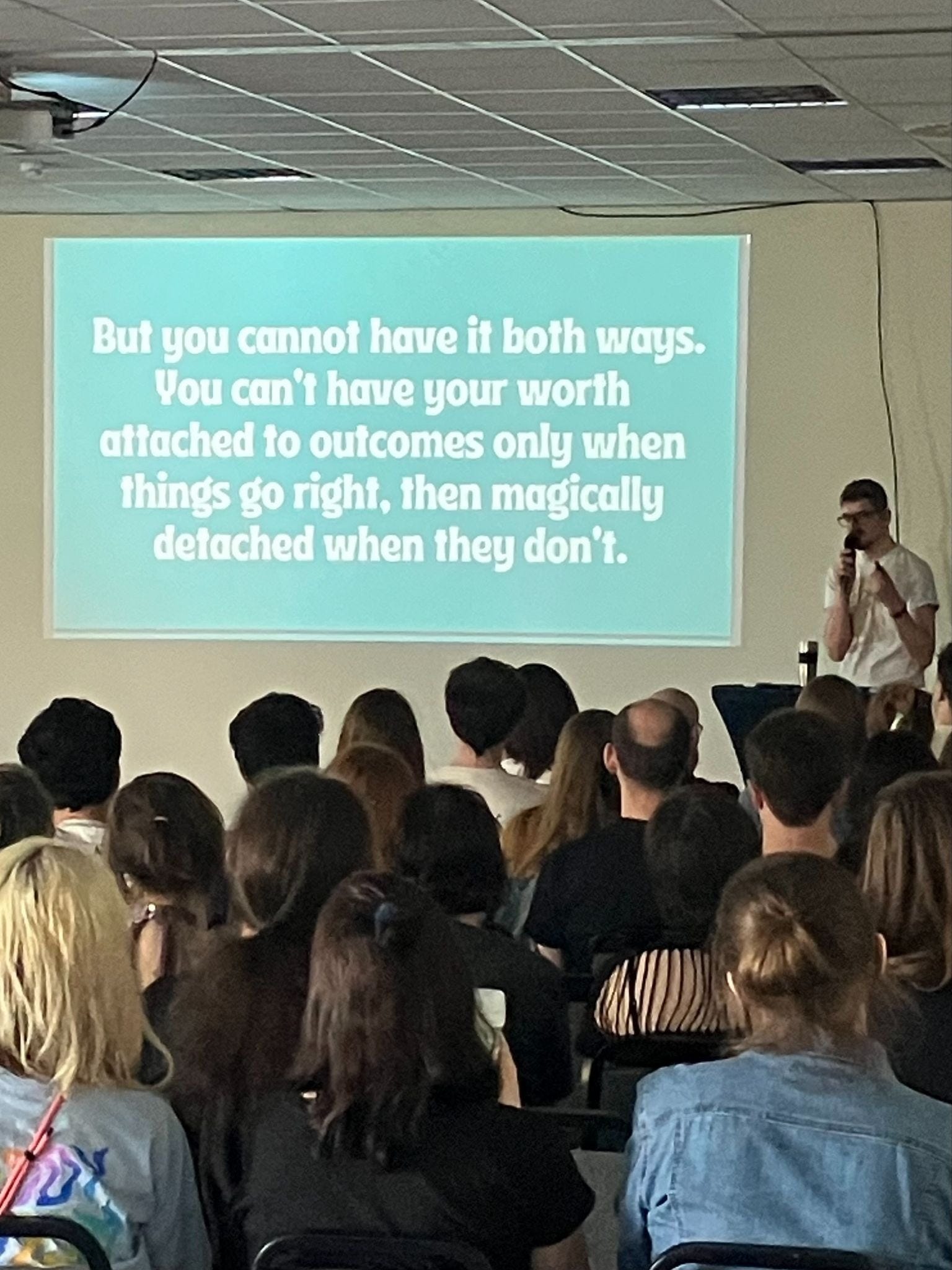
If the bill had stalled on a 6-6 vote, would that be good evidence the strategy was flawed all along? In that timeline, should the PAF team be beating themselves up for their failure? If not, then the inverse can’t be true. This specific outcome was weak evidence. And in this regard, we probably can’t have it both ways:
Fortunately, I think the PAF team has better evidence. The relationships they’ve build across the local political scene, the ways they have embedded themselves into networks of influence, are harder to quantify, but deeper and more important in the long term.
We should try to measure the impact of our work, but carefully, wary of Goodharting. We should in some ways focus our evaluation inwards. Rather than only asking whether we got the outcome we wanted, we should ask whether we did our best work.
Principle #4: Refuse to be coerced
In the leadup to the conference, a handful of accounts on social media started a callout campaign targeting one of the activists involved. Few of these accounts were involved with any of the groups hosting the conference; several didn’t appear to have much of a history in the animal movement.
The allegations were not a new revelation to the groups organizing the conference. They had been investigated seriously when first brought. The person in question had made real mistakes and had paid a price for them. But none of his conduct came anywhere close to the words being thrown around online, even if you took the link to a lengthy narrative about him being shared around at face value.
The organization had a conflict policy, and they had followed it: conversations mediated, consequences levied, and everyone moved on. But now it was back.
The cancel campaigners posted public callout posts. They also started privately messaging other people affiliated with the conference in any way. In these messages, they made their goals clear: stop this person from being welcomed at the conference and “elevated in the movement”, even if it took shutting down the entire event.
With just two weeks to go, conference organizers received a call from one of the most prominently featured speakers. She was in tears. She had been contacted by people demanding that she cut her ties with the conference unless the accused person was barred from attending. They had warned her that if they didn’t get their way, the media would pick up the story, exposing all the organizations involved—including hers—for “harboring sexual predators.” She presented an ultimatum: either the accused activist was out of the conference, or she was.
The organizers knew the facts of the case. They knew that this campaign was not fair or proportionate– as any reasonable person could see for themselves, if they were willing to read past the sensational language and look at the facts that both parties to the original conflict agreed on. But fair or not, they were faced with the prospect of losing a key supporter of the conference, just as the movement finally appeared to be entering an era of unity.
What would you do, reader?
[I’ll wait.]
Here’s what they did: they caved. They kicked out their friend, someone they knew to be a deeply good person who had shown some pretty ordinary lapses in judgement, banishing him not just from the conference but from the entire organization. They were trying to do the best thing for the organization—for the animals—and they thought that an injustice against one person was preferable to a conflict tearing the movement apart.
This was the wrong decision.
First of all, it didn’t work. Sure, that one featured guest still joined the conference. But the cancellation campaign online barely slowed down. They continued calling out the organization for being too slow or reluctant to “hold sexual predators accountable,” and soon they’d moved on to targeting other individual members for transgressions ranging from politically transgressive jokes to (often inaccurate) speculations about privately held views. The organizers had demonstrated that claiming victimhood status was a guaranteed way to win any argument, a lesson many more in the movement took to heart and acted on in the years to come. The frequency of cancellation campaigns targeting them only increased.
Oh, sorry, I forgot to mention: all of this wasn’t GARS. This story is about DxE and the Animal Liberation Conference in 2018.
But as you might have guessed, an almost identical story played out in the leadup to GARS this year, with one key difference—the response from the organizers—making it another revealing case study in how much our movement has changed for the better.
What was different? First and foremost, the GARS organizers showed courage and loyalty. They stood up, not just for their friends, but for the truth. They didn’t let cancelers online bully them into saying or acting on things they didn’t believe. They learned the right lessons from the first story and dozens of others just like it: that letting social media controversy dictate your actions in the real world only invites more and worse bullying.
Certainly, the context has changed since 2018, making it relatively easier to take a stand like this. We’ve all been through too many cancellations to take them at face value. Everyone is more likely to slow down and think rather than follow our first Pavlovian reaction to emotionally charged keywords.
Digging your heels in
Looking through old threads in the Anima slack to orient myself, I found one where Kuba described this new attitude:
After thinking more and more about this category over the last years, I generally think the correct response is to:
have extremely high bar for changing anything because we feel discomfort (and usually do nothing for good meta reasons),
be very suspicious of the discourse where the discomfort due to encountering ideas is the main point,
optimize for solutions that build emotional resilience…
We don’t want people who make their emotional state a tool to keep others hostage. If anything, due to animal advocates being extremely empathetic, we should be careful when people invoke their emotional state - they are wielding a lot of power - put themselves in power imbalance that favors them - they can force others to change tasks and their outcomes way easier than people who are not using such emotional states. I have seen this play out multiple times. Just adding “I feel bad because of that” makes people alter their decision making with less scrutiny that they would expect of others. Just like with any power dynamics, this should be carefully monitored…
This doesn’t mean lack of compassion, supporting each other or having poor mental health, we are here for each other and internal support is what powers our ability to go forward, but people should work on being stronger and we should have certain threshold we don’t want to go below
From other conversations with Kuba, I think the “good meta reasons” he’s referring to is the fact that it is sometimes rational to dig your heels in.
We can all think of a situation where you—person A—could have easily been persuaded to do X or were even considering doing X. Suppose X is something reasonable or low-cost, on the order adding new language to your organization’s anti-harassment policy. The language isn’t exactly bad, though you don’t think it’s necessary and it wouldn’t have made a difference in the situation person B is upset about. However, when person B comes in and starts demanding you do X, suddenly you have an irrational urge not to do X. You dig your heels in.
But heel digging is not always irrational! Sometimes showing that you are not the kind of agent who can be pushed around by coercive behavior is more important than X, even when X is a trivial or sensible or even a good thing to do.
I have a secret for you, reader. From the perspective of the companies we target, nearly every serious pressure campaign fits this pattern. Say we want a fashion company to drop fur. We ask them, and they say no. Then we escalate. Our goal is to ratchet up the pressure to the point that continuing to resist our demand is more costly than simply surrendering. This is the basic logic of pressure campaigns.
But in truth, this is only part of this picture. This story only accounts for the immediate campaign. We can cause companies enough pain that it is locally optimal for them to cry uncle. But if companies were decision-theoretically optimized, they would think ahead to what comes next.
When companies cave in to a pressure campaign, they reveal—not just to us, but to all potential future activists, for any issue—that they are the type of decision agent who can be coerced into changing their policies by things like comment storms, home demonstrations, and negative PR campaigns.
So why do they cave? Well, one answer is that they haven’t studied up on obscure decision theory literature from the Bay Area rationalist scene. But a more satisfying explanation is that 1) the company and 2) its human decision makers are misaligned. Yes, caving invites more campaigns against that company in the future. But that doesn’t matter to individual board members who are being woken up by protesters at 2 am, because they will probably be well into retirement by the time the next campaign starts.
A place for loyalty
Animal abusing board members have a good reason not to dig their heels in. But what about you and me? Well, DxE learned the hard way back in 2018 what happens when you don’t hold the line against online bullying. You just invite more of it.
That doesn’t mean digging your heels in is easy. Just like a company targeted by a pressure campaign, to dig your heels in, you have to be tougher than your counterpart. If you don’t think you can outlast them, it’s better to cave sooner.8 To dig your heels in rationally, you need to make an informed decision about just how much it is worth to show your strength on a particular topic.
The lesson behind this whole fourth principle is that activist organizations should be willing to pay nearly any price to resist cancel culture, because the threat it poses is existential. I can’t count how many promising activist groups I have seen completely disintegrated by this behavior.
Because animal advocacy attracts highly compassionate, empathetic people, we are particularly vulnerable to campaigns that manipulate emotions. If we let that dictate our decisions, we might as well give up preemptively. This is one of the principles Kuba would sooner burn his organization to the ground than violate– a lesson he, like the GARS organizers, learned the hard way.
The story this time doesn’t end perfectly. While his friends stuck by him, the person most targeted by this year’s campaign decided on his own to sit GARS out. He didn’t want to distract from the goals of the summit, and on a personal level, years of online harassment are taking a toll on him. His fellow organizers were saddened by his decision, but they supported him.
But, then, that’s not really the end of the story. At the summit, every time anyone mentioned his name on stage, the entire room burst into applause. It wasn’t just the conference organizers sticking by him. This was the entire grassroots community saying No to online bullying.
Principle #5: Long-term power via short-term impact
At its most intelligent, the debate between abolitionist and incremental strategies often rested on a crux about short-term vs. long-term objectives. The discussion went something like this:
Abolitionist: The concrete changes we can achieve for farmed animals at scale today are so incremental that they aren’t even worth our time. The problem is that we collectively don’t have enough power to influence the world in bigger ways. That’s what we need to change. Rather than optimizing for short-term impacts, which right now are too small, we should optimize for long-term power. This includes increasing the number of people involved in the movement, especially volunteers, and increasing public awareness of cruel industry practices and philosophical arguments for animal rights.
Incrementalist: This relies on a lot of delicate assumptions holding over a long period. For instance, most people who get involved in the movement don’t stay involved for very long. You could try to change the experience of volunteering in the movement so that people stick around longer, but we don’t have any precedent suggesting that will succeed. More broadly, “power” as you are describing it is hard to measure and even harder to attribute. My worry is that you’ll work on this for years without knowing whether you made progress, or if so, what worked and what didn’t.
Abolitionist: Some aspects of power are hard to measure, but not all. Surely, to win bigger changes, we need the public to be more on our side. I’m excited about campaigns that target the public with a strong abolitionist message, to start to normalize our more ambitious goals. We could run protest, outreach, and media campaigns, then use polling to see if public support for animal rights increased.
Incrementalist: Oh, you mean polls like this one, showing that in the aftermath of Animal Rising’s disruptions of the UK Grand National horse race, there was a decrease in the number of people who found it problematic to use animals for entertainment? The before-and-after poll was designed in collaboration with Animal Rising themselves.
Abolitionist: Huh. Ok, I admit this looks bad. But in a sense it misses the point for me. Like I said, I’m focused on long-term power. This measured support right after the protest. I’m not surprised that there might be a short-term backlash or “radical flank effect”, but I think that if protests like this were more common, the trend over the long term would look different. Plus, the study itself shows that there was a large spike in signups to Animal Rising, so while it alienated some people, it excited others and got more people involved in the movement.
Incrementalist: But if you just get more people involved in a form of protest that is actually alienating people, isn’t that even worse? More importantly, this seems to confirm my worry about measurability. I acknowledge that this is only modest evidence against your strategy, but it’s the only evidence we have right now, and you’re dismissing it.
Abolitionist: That’s not true. I am just looking at a different type of evidence from you. You’re only considering evidence directly from animal advocacy, which is limited because there’s never been a successful movement to end factory farming. I’m drawing on historical lessons from other social movements, like women’s suffrage or the civil rights movement.
Incrementalist: You’re right that I’m wary of extracting general lessons from past movements, since I think those lessons often fit our prior beliefs. For instance, I see in the US civil rights movement a movement that for decades clocked up small achievable incremental legal and political wins in service of several larger incremental wins (two key federal laws and several Supreme Court rulings) but that failed in its more radical goals (racial and economic equality.) But I suspect this is largely me projecting my beliefs on the past.9
Abolitionist: So do you have a better plan to end animal exploitation?
Incrementalist: I admit I’m less optimistic than you about how soon we could end factory farming, and even less so about ending all exploitation of animals. But more fundamentally, we’re looking in through opposite ends of the telescope. You’re starting with the goal you want to achieve and working backward to ask what would need to happen. I’m starting with where we are and thinking about what seems possible. I want to continuously ask what’s the best thing we can do now. Even if I was working backwards like you, I think I’d come to different conclusions, but I think that’s pointing to the same difference in how we think.
Abolitionist: There’s no question we think differently. Don’t you see how the outlook you’re describing is myopic? If you only focus on the immediate wins without thinking a few steps ahead, we’ll never set ourselves up to achieve bigger things in the future. You would have us spend down all the capacity we have on a short-term objective without investing in the capacity for the objective after that. And I don’t just mean that in the abstract. Recently, you’ve pivoted from building a grassroots movement of volunteers to building up professional, full-time NGOs. Most of the people you’ve hired started out as volunteers, but now your campaigns are designed without a thought for creating transformational experiences for volunteers. In a few years, you’ll have no new up-and-coming leaders. This is just one example of the ways that you ignore the importance of building movement power.
Incrementalist. Yeah, I have been struggling to engage volunteers recently, but I mostly think that’s because we’re running incremental welfare campaigns—which are effective and likely to help way more animals—rather than symbolic campaigns, which are sexier but less impactful. Recruiting volunteers is good, but eventually we need to actually turn that into change for animals. I’m just not confident enough to put our energy today into strategies that might bear fruit years in the future. Not without a time machine to tell us what the real effects will be.
Abolitionist: AAARGH! What was that sound? Wait, holy shit, where did you come from? Who are you? And what is that thing?
Winner: In the spirit of the moment, I will answer your questions in reverse order. This is my time machine. I am both of you, from the future. I just came back from 2026.
Incrementalist: How can you be both of us?
Winner: Simple, you aren’t actually people, you’re just idealized avatars of common viewpoints, and in my timeline, those viewpoints have converged.
Abolitionist: Me, merge with him? Never!
Winner: Sorry, but it’s true. It turns out the future is hard to predict after all.
Incrementalist: Let me guess. You’re here to resolve the discussion we’re having?
Winner: Of course! I knew you’d understand. Here’s the essence of your misunderstanding: the two of you are debating a tradeoff between short-term incremental wins and long-term power building. But these are two sides of the same coin. Short term wins are how we build long term power– if we don’t forget that building power is one of the goals. First, small, incremental wins keep our activists and donors motivated. Second, they enable us to enmesh ourselves into networks of elite influence. For instance, pursuing a modest legal reform through a city council or state legislature gives us a reason to ask for meetings with lawmakers, build relationships with them, and accumulate favors from other political power brokers. Third, small wins let us build up durable organizations that have the skills and capacity to run bigger campaigns.
Abolitionist: But what about targeting public opinion directly?
Winner: In some ways, you are overestimating the importance of public opinion, and the durability of it. As far as there is such a thing as the “general public”, they care a lot about a few hot-button political issues, but in most regards, they are passive recipients of social norms. Their world is shaped by bureaucratic institutions.
People look to public and private institutions for signals of what is and isn’t moral. These institutions have their own internal logic and incentives, which are often shielded from the opinions of the general public. This is bad for animals now because it lets companies abuse animals in ways most people find horrible. But if we learn to navigate these bureaucracies effectively, we could turn it to our advantage, and win policies that might even be more impactful than what the median member of the public would support. Most importantly, implementing those policies sends a stronger message than any protest campaign that a particular form of animal abuse is not OK.This is especially true given how short people’s memories are. The harmful effects of the Grand National disruption didn’t stick, but any boost in public opinion would be just as ephemeral. The same thing has happened for animal rights in the past. At different points during the 20th century, there were major campaigns against vivisection, but they fizzled out without winning concrete changes, and any gains in public opinion evaporated.
Incrementalist: It sounds like focusing on short-term wins was basically the right approach.
Winner: Not so fast. There’s a way to run incremental campaigns that invests in long term power, but it doesn’t necessarily happen by default.
The abolitionist was right that neglecting your leadership pipeline was a mistake. The movement in my time is facing a critical shortage of skilled campaigners. All the best campaigners started out as grassroots volunteers, but the pivot to an NGO model cut off the very pathway they took. There’s been some silver lining to this: the need for new grassroots energy brought the incremental welfare campaign movement back into partnership with the abolitionist grassroots. But overall we are still majorly constrained on leadership development.
This is only one example of incremental campaigns neglecting power. Groups focused on lobbying mistook having the governor’s phone number for political power. This works for extremely minor asks, and it’s good to lap those up while we can, but to be a real threat inside legislatures, we need a base of organized voters. We’re scrambling to bring grassroots organizing into alignment with a desperately important political effort, but we may have acted too late.
Finally, while you were right to focus on concrete wins, you underestimated the value of wins that prioritize symbolic power over helping the most animals now. A recent open rescue campaign at a beagle factory farm for vivisection companies only managed to rescue a few dozen dogs, but it became one of the biggest national stories our movement has ever seen. That inspired elected officials from across the political spectrum—including the far right—to put out statements sounding like the Animal Liberation Front Press Office, calling people heroes for trying to break into a factory farm with buzz saws. And that in turn helped mobilize national figures for a congressional fight over pig welfare. Evaluating that campaign in terms of the number of animals helped directly would have missed the whole picture.
Abolitionist: So that’s the answer. We build power by notching up incremental wins. I can live with that. Come to think of it, it’s kind of beautifAAAAH! God damn! Can I get some warning next time? That was too close for comfort.
Winner: Oh, no.
Survivor: Oh, yes.
Incrementalist: That’s the same machine, right? It’s in pretty bad shape, though. So are you, honestly. Let me guess, you’re from later still? When, exactly?
Survivor: Can’t tell you. And before you ask, no, I’m not here to drop some new revelation on you.
Winner: I was just finishing up explaining the synthesis, building power through incremental wins. It was so elegant…
Survivor: Oh, I remember giving that speech like it was today. I was very pleased with myself. That’s rather the problem.
Abolitionist: What’s wrong with it?
Survivor: Nothing’s wrong with it. It was perfect. So perfect it made us complacent. When the ground changed underneath us, we didn’t notice. We missed out on the debates we needed to be having– things you aren’t currently capable of imagining. You’ll see. Or you won’t. That’s sort of the point.
Abolitionist: So you’ve come back to give us the real answer?
Survivor: Aren’t you paying attention? If I told you the real answer, it would do to you exactly what my answer did to me. It would feel so satisfying that you’d stop searching. All I can promise you is that whatever you’re most confident about right now is the thing you’ll be most embarrassed about in eight years. I’d have killed to hear that in 2026. No offense.
Winner: None taken, I guess.
Survivor: Anyway, I need to get out of here before I say too much. Oh, one more thing though: don’t buy stock in Beyond Meat.
Escaping the Net
Since I started publishing this blog, I’ve managed to confuse a lot of people. In reaction to a post about the campaign to rescue beagles from Ridglan Farms, an old friend from abolitionist world was overheard saying “Oh good, I was worried for a while that we’d lost Aidan to the welfarists.” But not everyone was happy; another commenter pleaded “I hope you focus back on strategies proportional to the problem we face. You’re too smart for small ball, symbolic stuff.”
I must not be that smart, because if I was, I would have managed to communicate by now what both of these people are missing.
Team Division is flabbergasted by Winners. Flummoxed. Bamboozled. At one moment, they see us on one side of the musty old squabbles they still cling to, but then they blink and we’re gone, only to appear again where they least expect us. Our joyous dance travels across dimensions they can’t even see.
Team Win has integrated the ideological disputes of last decade into a more sophisticated strategic worldview. We’re free from the net. What will we feed on now?
Plenty, it turns out. There’s lots more to be discovered. In fact, at first glance, there appear to be more differences and disagreements than similarities between the groups I highlighted in this post.
Consider Anima International and the hydra (mine and Ben Newman’s unofficial name for the multi-headed coalition of ICAW, AAC, and CAFT, which hosted GARS.) Both groups have focused on both fur and cage-free campaigns in the last year, among others. But Anima prefers a slower escalation ladder within their Fair Cop framework, where the hydra’s whole brand is built around maximum confrontation. The hydra is largely volunteer-driven, while Anima has consciously de-emphasized its volunteer operation in recent years.
These details are important and interesting, worthy of analysis in their own right. But I think they are fundamentally unlike the old ideological disputes. They are specific adaptations to each group’s strategic context. Both groups could learn a lot from each other, and I hope they will.
But after that, I hope they’ll go their own way.
Build on,
Sandcastles.
I know this sounds weird but there wasn’t a precise first year or a last year, because it evolved from one thing and evolved into another thing.
I can’t actually remember who told me this story. It was a long time ago so they must have been an early adopter. If it sounds familiar, tell me who it is and I’ll update! EDIT: I’m told Paul Shapiro has been doing this bit for over 20 years so he’s currently my leading candidate for attribution.
Solid substacker, you should subscribe
Animal abusers hate them!
In a separate context, I’ve offered to edit Kuba’s English to be more idiomatic and he emphatically refused, explaining that he wants his authentic voice to come across in his writing, Polish idiosyncracies and all.
Less the opportunity cost of spending time engaging with criticism from sources that have a poor epistemic track record.
If you’re curious, many of the same points were covered in this recent post by Tyler Lang, the strategic genius behind Coalition to Abolish the Fur Trade and one of the former ALF prisoners who used to suspect Wayne’s whole open rescue strategy of being an FBI honeypot.
This is an oversimplification. You might be willing to signal that you will cave to a campaign that costs the people targeting you a certain amount, but not to less costly campaigns, in which case it could be rational to fight a campaign for a while even knowing you’ll eventually surrender.
Regular readers might recognize this as an actual Lewis Bollard quote
Great stuff. Thanks for sharing your journey and lessons.
And thanks for the Lewis quote - always worthwhile.
Re: the "Will you get your hair cut and put on a suit" - I don't know who said it first, but Paul Shapiro did a version of that well over 20 years now.